
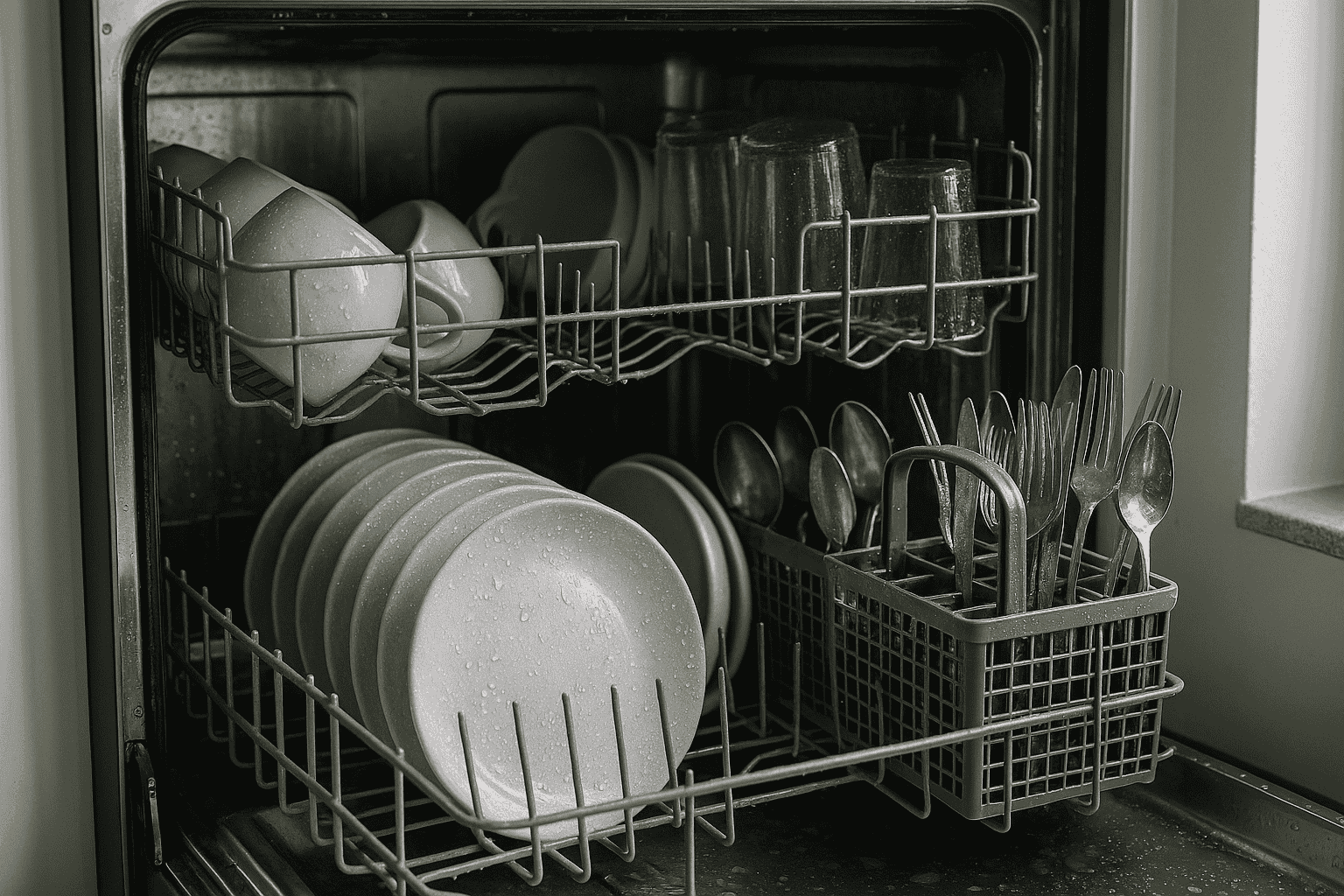
Wet dishes at the end of the cycle don’t always mean your dishwasher is broken. How a dishwasher dries depends on the model, and many modern dishwashers are designed to leave some water on plastics. Start with the simple fixes, then check for the parts that do fail.
First, How Does Your Dishwasher Dry?
- Heated dry: a heating element at the bottom of the tub warms the air. Many GE, Whirlpool, KitchenAid, Maytag and Frigidaire dishwashers work this way, often with a “heated dry” option you have to select.
- Condensation dry: there’s no exposed heating element. A hot final rinse heats the dishes, and moisture condenses on the cooler stainless steel tub walls. Bosch, Miele and Thermador dishwashers commonly dry this way. Rinse aid is essential.
- Fan-assisted or auto-open dry: some models use a fan or open the door slightly at the end of the cycle to let steam out.
Knowing which type you have tells you whether “not drying” is normal for the load or a real fault.
Simple Fixes That Solve Most Cases
- Use rinse aid. This is the biggest single fix, especially on condensation-dry models. Rinse aid helps water sheet off instead of beading. Fill the dispenser and check its dose setting.
- Select heated dry or extra dry if your model has it. Some eco cycles use less heat and dry less.
- Run the hot water at the sink before starting the dishwasher, so it fills with hot water from the start.
- Load for drainage. Tilt cups and bowls so water runs off, don’t nest items, and don’t overload the racks.
- Unload the bottom rack first, so water from cupped items on top doesn’t drip onto dry dishes.
- Expect plastics to stay damp. Plastic holds less heat than glass or ceramic, so it stays wet on almost every dishwasher.
When It’s a Faulty Part
Heating element
On heated-dry models, a failed element means no drying heat and often lukewarm wash water too. A technician tests it for continuity. A burnt spot or a break can sometimes be seen.
High-limit thermostat or temperature sensor
If the dishwasher can’t measure or control temperature, it may not heat at all.
Vent or fan
Models with a drying vent or fan can fail to release the moist air if the vent is stuck or the fan stops.
Control board
Less commonly, the control doesn’t switch the heater or fan on.
Signs It’s Time for a Repair
- Dishes used to come out dry, and now even glass and ceramic are wet with rinse aid in the dispenser.
- The wash water no longer feels hot at the end of the cycle.
- An error code relating to heating or temperature.
- Water pooling in the bottom of the tub after the cycle. That’s a drain issue, not a drying issue.
A dishwasher that’s both wet and leaking should be checked soon. See our guide to fixing a leaking dishwasher.
Frequently Asked Questions
Why are my dishes still wet after the dishwasher finishes?
Most often: no rinse aid, the heated dry option is off, the dishwasher dries by condensation, or the items are plastic. If none of these apply, the heating element or thermostat may have failed.
Is it normal for a Bosch dishwasher to leave dishes wet?
Some moisture, especially on plastics, is normal for condensation drying. Rinse aid and a hot first fill make a big difference.
Can I open the door to help dishes dry?
Yes. Opening the door slightly after the cycle lets steam out and speeds up drying.
Is a dishwasher that doesn’t dry worth repairing?
A heating element or thermostat is a common, reasonable repair. We’ll check the age and condition of the dishwasher and tell you if it’s worth it.
Book Dishwasher Repair
We repair dishwashers from Bosch, Whirlpool, KitchenAid, GE, Samsung, LG, Maytag, Frigidaire, Miele, Thermador and more, in Sacramento, West Sacramento, Davis, Woodland, Dixon, Vacaville, Elk Grove and Rancho Cordova. See our appliance repair services, call (510) 677-7166 or book an appointment online. The service call is $80.